  1. Blog/

The Beauty In Numbers, 1b: A circle, a spiral, a flower.

Author
Lance Barker
Exploring my own creative expression and building things that help people.

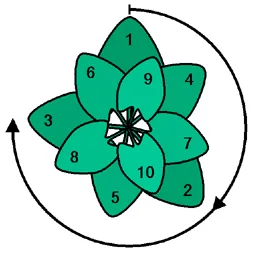
A curve that starts from a point and moves farther away as it revolves around the point is called a spiral.

These happen everywhere in nature.  Spiral curves are seen in the way plants arrange their leaves in circular patterns. It turns out, rather beautifully, that these plant spirals are often formed according to something called the Golden Angle, which in turn, is related to the Golden Ratio, also seen in the Fibonacci series. I won’t go into the Golden Ratio here( dude, look it up! ), but the Golden Angle seen below as angle b can be thought of this way: the ratio of the arc of b to a is the same as the ratio of ***a ***to the entire circle.
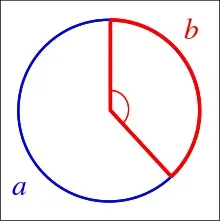
Another way to calculate it: Golden Angle = π(3 − √5) = roughly 2.4 radians = roughly 137.5 degrees.

Now, if we plot 500 points, plugging in the Golden Angle in R, the code would look like this:

Defining the number of points
#

points = 500

Defining the Golden Angle
#

angle = pi*(3-sqrt(5))

t = (1:points) * angle

x = sin(t)

y = cos(t)

df = data.frame(t, x, y)

resulting in
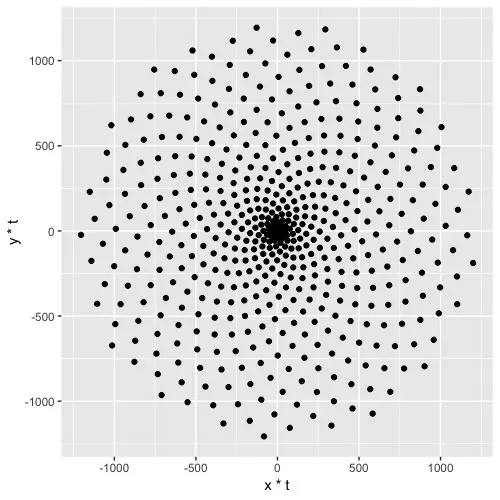
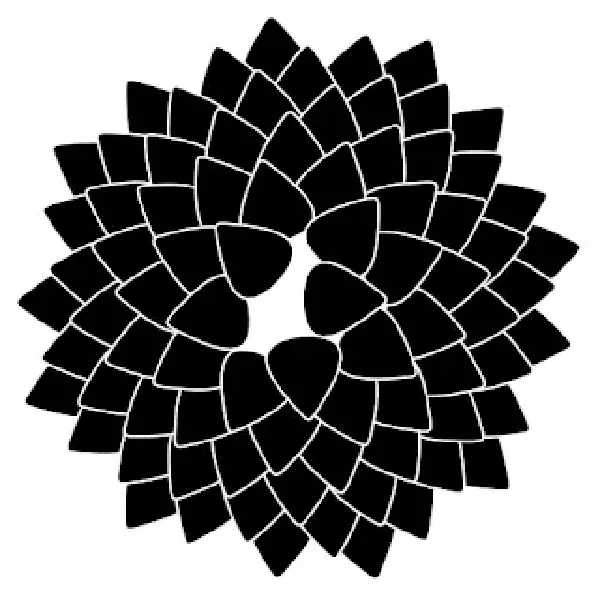
and if we clean it up and add some color, we get
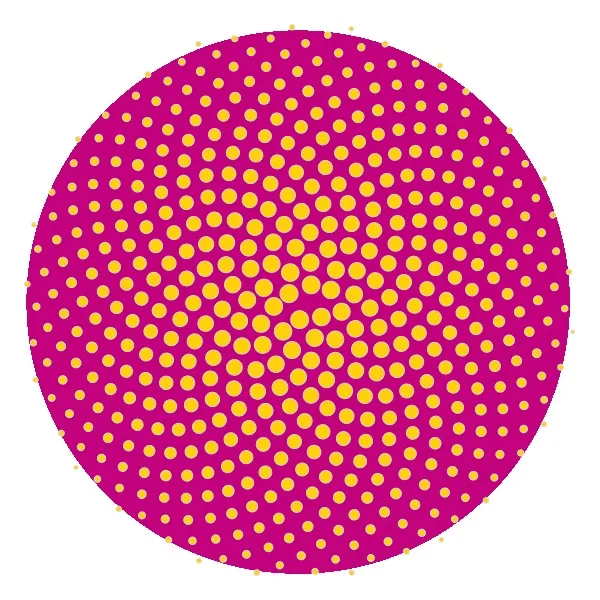
Cool. I LOVE this!
Related

The Beauty In Numbers, 1a: Plotting a circle.

Let’s use math to draw pictures, shall we? There is a wonderful world out there of representing patterns in nature, especially flowers, in mathematical terms. Ever gazed into a sunflower? I hope so. I’m learning and exploring as I go along here, so I’ll start with simple circle plots and move on from there. But where to start? How about Pythagorus?

Hello, you gorgeous algorithm you.

·1 min
Can there be beauty in math? I think so. I want to experiment with this idea for awhile. So, here goes a new series: The Beauty In Numbers. I’m going to off on a tangent (!) and study mathematics and art together.

World as lover, world as self.

·1 min
"… it’s Ok for our hearts to be broken over the world. What else is a heart for? There’s a great intelligence there. We’ve been treating the earth as if it were a supply house and a sewer. We’ve been grabbing, extracting resources from it for our cars and our hair dryers and our bombs, and we’ve been pouring the waste into it until it’s overflowing, but our earth is not a supply house and a sewer. It is our larger body. We breathe it. We taste it. We are it, and it is time now that we venerate that incredible flowering of life that takes every aspect of our physicality."