Ed Gehrman lives in Quincy, California.
Not the Massachusetts one. The Northern California one — small enough that the coffee shop remembers your order, high enough in the Sierra Nevada foothills that the air still smells like pine sap in May.
We’ve been recording conversations for a while now. Ed has theories.
Big ones. About monotremes — platypuses, echidnas, the oldest surviving lineage of mammals — and about what happened in Roswell in 1947. Ed believes the creature in the autopsy footage isn’t from another planet. It’s from this one. Vastly older than us. Evolved on a parallel track for thirty-five million years. Not a visitor.
A neighbor.
He came to this not through mysticism but through film research. He found the cameraman. He obtained the death certificate. His posture is empirical, almost stubbornly so — the kind of person who follows evidence wherever it leads and is no longer surprised by where it goes.
In the last few years, Ed and I have been recording conversations for his blog at monotremenation.blogspot.com and for a book about his life and his research. So when he said he also wanted to write a one-act play about consciousness unfolding — that was the phrase he used, consciousness unfolding — I said yes before he finished the sentence.
Then he mentioned Arthur Young.
Arthur Young invented the Bell helicopter. He was also a philosopher. In his second life — the longer one — he wrote The Reflexive Universe, a book that proposes that consciousness isn’t a side effect of biology. It’s woven through everything. Not metaphorically. Mathematically. Young modeled the universe as a torus — a donut with a hole — awareness moving through stages, looping back on itself, each cycle integrating what came before.
Not progress in a straight line. Recognition in a loop.
Ed loves this. And once he said it, I couldn’t unhear it.
If Young is right — if consciousness isn’t produced by brains but transmitted through them — then every aha moment in human history looks different. Newton watching the apple. Darwin on the Beagle. Franklin in the garden.
Not discovery.
Recognition.
I suggested we use Ed’s cohabitants as the vector. The monotreme — old, a holdout from the dinosaur era, operating on frequencies we don’t have names for — finds a mind that’s open. Not to add something new. To complete a loop. The fruit was on the tree before you shook it. Someone just needed to look down. Staging a monotreme presented its own problems. Young’s idea fit better. The lights. The drift. The thing that doesn’t explain itself.
I picked Franklin because of “self-evident.”
Those two words changed everything. Not “sacred and undeniable” — which is what Jefferson originally wrote, and which Franklin apparently didn’t like. The shift from argued for to known is the whole play. A man sitting in a garden at midnight, with something he cannot explain, finally finding the word for a feeling he’s had his whole life.
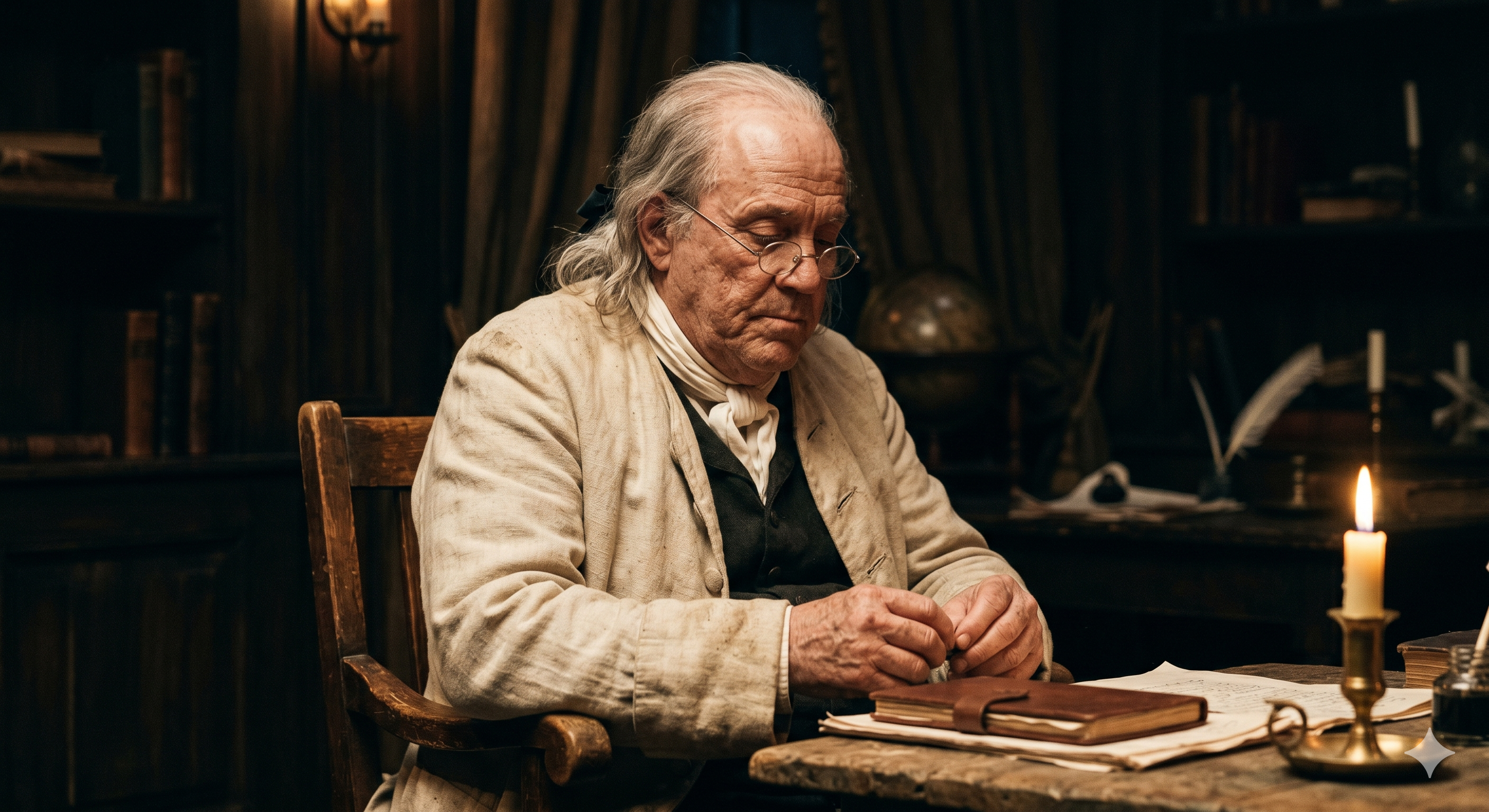
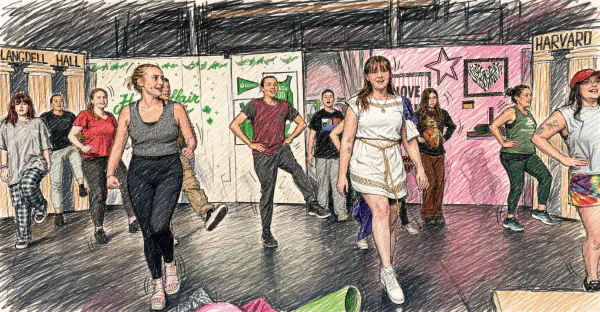
The AI film decision came naturally. Ed asked if I thought we could stage the play at our local theater where I have been involved in various productions for a decade. I said it would be possible, but would have its own challenges. I’ve been working with computer graphics for years. When AI filmmaking arrived, I was already reaching for it. AI filmmaking is a thing. A big thing getting bigger. I said, “Let’s make an AI film about a one-act play.”
Ed is 79. He dictates, I transcribe, Claude drafts. At some point we looked at what we had and realized we weren’t just writing a play. We were building a production. The Messenger — that’s what we call the presence in the garden — doesn’t have to be imagined. It can be rendered.
Theatrical. Painted flats. Cyclorama sky. Practical stage lighting in amber, cobalt blue, pale gold.
Not photorealistic. Not cinematic. Something that looks intentional the way good theater always does — sets that are clearly sets, props placed with purpose, empty stage space that’s part of the design.
We’re calling the series The Messengers. This is Play One. There will be others. Every historical inflection point has one of these moments behind it, we believe. The transmission that preceded the shift. The loop closing.
The play follows.
SELF-EVIDENT
A One-Act Play — The Messengers, Play One
From ideas by Ed Gehrman, Arthur Young, and Lance Barker
Written by Lance Barker
Original interview with Ed Gehrman and Lance Barker recorded Quincy, California, May 19, 2025
Copyright © Lance Barker, 2026. All rights reserved.
NOTES on the Arthur Young connection
Arthur Young (1905–1995) was the inventor of the Bell helicopter and, later in life, one of the most original thinkers about consciousness and the nature of the universe. His central work, The Reflexive Universe (1976), proposed that consciousness is not an accident of biology but a fundamental property woven through all of existence — from the behavior of photons to the choices of human beings. Young believed the universe is not a machine running down but a purposive process evolving toward greater awareness and freedom. His ideas about process, purpose, and the pervasiveness of consciousness in nature form the philosophical foundation of this play.
The Messengers are a theatrical expression of Young’s idea. They are not supernatural visitors. They are not from somewhere else. They are what Young would call the consciousness of the universe itself — ancient, patient, moving through the world on its own track, arriving at minds that are open enough to receive what it carries. When the Messenger finds Franklin in the garden, it is not delivering a message from the outside. It is completing a loop — bringing into awareness something that was always already true. Franklin does not receive a revelation. He receives a recognition.
VISUAL DIRECTION
This is a one-act play rendered as AI filmmaking. The aesthetic is intentionally theatrical — simple, intentional, and in the tradition of elevated community theater production. Sets are stage sets: painted flats, cyclorama skies, practical candle and instrument lighting. Props are placed with theatrical purpose, not realistic abundance. Empty stage space is part of the design.
The implied camera position is from the house — a respectful medium distance, not cinema close-ups. The frame lets the theatrical space breathe.
The Messenger is a practical stage lighting effect: colored light instruments (amber, cobalt blue, pale gold) controlled by a technician in the booth, drifting slowly and deliberately. Not an animal. Not an insect. Not a natural phenomenon. A light cue with intention.
SYNOPSIS
Philadelphia, June 1776. Benjamin Franklin and John Adams are trying to finish a document that keeps sounding like arguments to be made, not truths to be recognized. Franklin steps into the garden alone. Something finds him there — not a creature, not a visitor, but a presence: small colored lights that drift close and stay. He sits with them for a long time in silence. Something passes. Not words. More like the feeling you get when someone shakes a tree and all the fruit falls at once. You knew the fruit was there. You just hadn’t seen it fall.
When Franklin comes back inside, Adams is still writing at the table. He does not look up. He does not know anything has changed. Franklin sits down. He picks up the draft. He crosses out two words and writes two others.
“Self-evident.” Not argued for. Known.
CHARACTER PROFILES
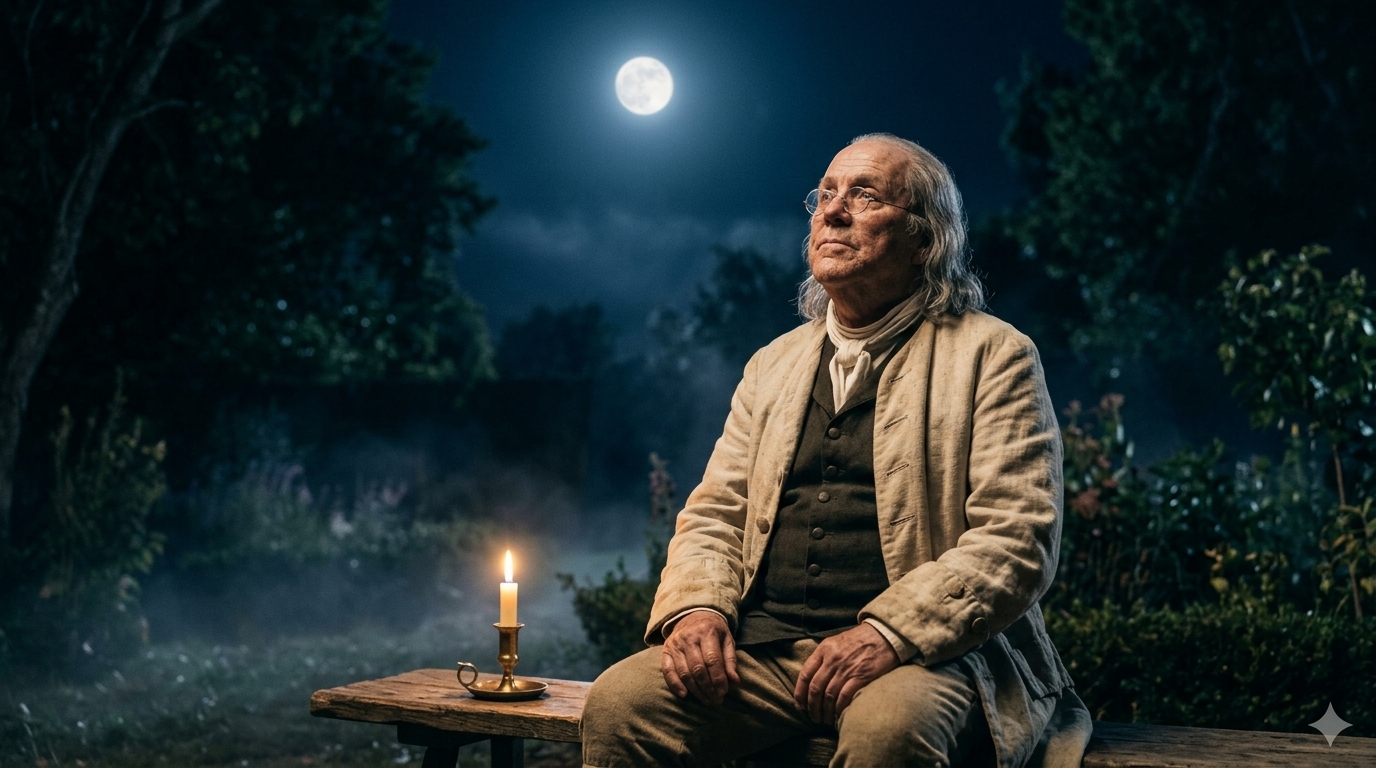
BENJAMIN FRANKLIN — Age 70. Heavy-set, wire-rimmed spectacles, white hair tied back. Plain linen coat, slightly dusty. A scientist and a politician — tonight he is neither. He is a man sitting quietly with something he cannot name. Until he can.
JOHN ADAMS — Age 40. Compact, intense, perpetually impatient. Dark coat, cravat precise. He argues everything. He is present in Scene 1 and Scene 5. He does not receive the Messenger. He does not know it was there.
THE MESSENGER — Not a character in the conventional sense. A presence. Practical colored lights — amber, cobalt blue, pale gold — that appear in the garden when Franklin is alone. Slower and more deliberate than anything natural. They do not speak. They transmit. The Narrator will explain what they are, to the extent anything can explain it.
SET DESCRIPTIONS
SCENE 1 — THE COMMITTEE: A plain wooden table, papers, inkwells, two candle stubs. Two chairs. Behind them, a painted flat of a dark window. Spare — these men are doing work, not performing history.
SCENES 2 AND 3 — THE GARDEN: Open stage. A wooden bench. One stylized tree flat at the edge. A black sky cyclorama with a paper moon. More felt than seen. The Messenger: practical colored lights — amber, green, soft white — drifting slowly, deliberately, close to Franklin, then still.
SCENES 4 AND 5 — THE RETURN AND THE WRITING: The same committee table. Adams still writing. Pre-dawn light beginning at the window.
THE PLAY
SCENE 0 — TITLE CARD
[VISUAL: Black screen. White Palatino serif text glows in: “SELF-EVIDENT”. Below it, smaller, italic: “Philadelphia — June 1776”. Gold edge light on the letters. Hold 5 seconds. Fade to black. Diegetic: a single distant church bell striking twice, then silence.]
SCENE 1 — THE COMMITTEE
Philadelphia. Late evening.
A plain table. Papers everywhere. Two candle stubs. FRANKLIN sits on one side, ADAMS on the other. Between them: a draft. They have been at this for weeks.
FRANKLIN picks up the page. Reads it.
[VISUAL: Low wooden table thick with papers and two inkwells, two candle stubs nearly spent. Two men opposite each other — one stout and wire-spectacled in linen, one compact in a dark coat. Both looking at the same sheet of paper. Warm candlelight on weathered faces. Diegetic: the faint scratch of a quill, distant street noise from outside, the creak of the building.]
FRANKLIN
“We hold these truths to be sacred and undeniable?”
He sets it down.
FRANKLIN
I don’t care for this phrase. It’s clumsy.
ADAMS
(picking up the page)
Sacred is Jefferson’s word. Every congregation in every colony will want to know whose sacred we mean. The Presbyterians will claim it. The Anglicans will dispute it. We will spend three months on sacred.
FRANKLIN
I know.
ADAMS
And undeniable is worse. The moment you call a thing undeniable, every man in the room wants to deny it.
FRANKLIN
I know that too.
Silence. ADAMS refills his quill.
ADAMS
Then what word do you want?
FRANKLIN does not answer right away. He picks up the draft. Reads it again. Puts it down.
FRANKLIN
I want the word that means — you already know this. Before I say it. Before anyone says it. You came into this room already knowing it. I want the word for that.
ADAMS
(a pause)
That is not a word. That is a feeling.
FRANKLIN
Then I want a word for the feeling.
A silence. ADAMS returns to his writing. He will work through the night if he has to.
FRANKLIN stands. He takes the candle.
FRANKLIN
I am going to get some air.
ADAMS does not look up.
ADAMS
Don’t be long.
FRANKLIN goes out.
[VISUAL: The table from above — papers, two inkwells, one man writing in the pool of candlelight. The chair opposite: empty. The door to the garden standing open a crack, the night visible beyond it. Diegetic: the scratch of Adams’s quill, a distant dog, summer heat through the open door.]
SCENE 2 — THE GARDEN
The garden outside the State House. Late. Quiet.
FRANKLIN sits on the bench. He sets the candle beside him. He looks up at the moon.
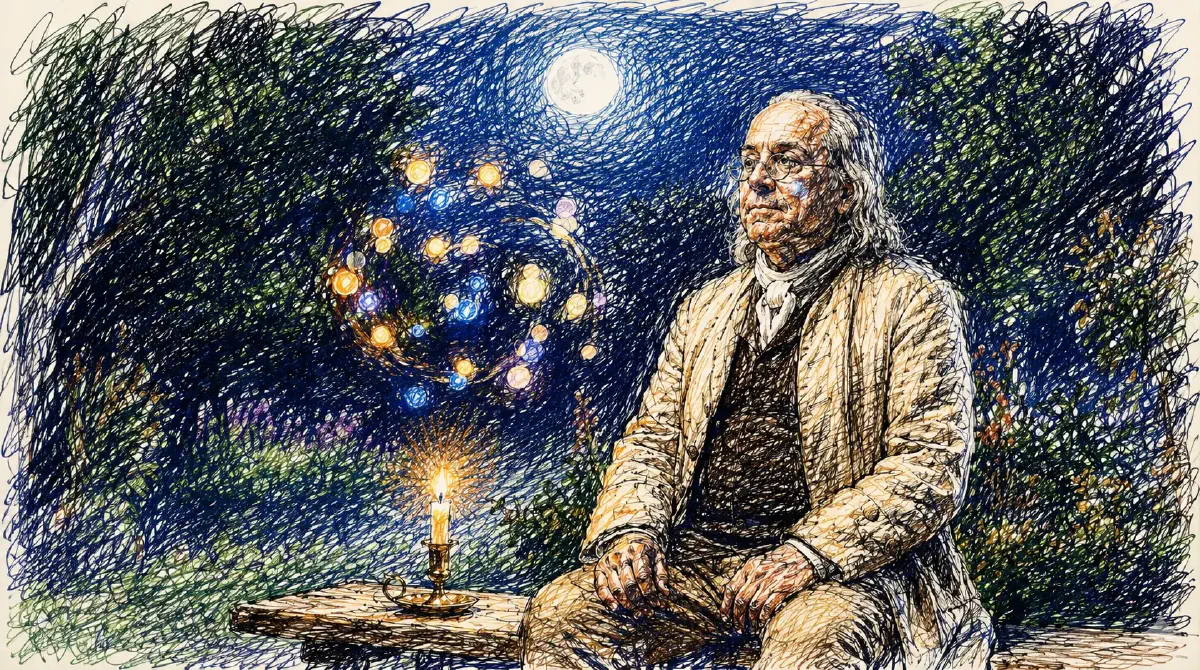
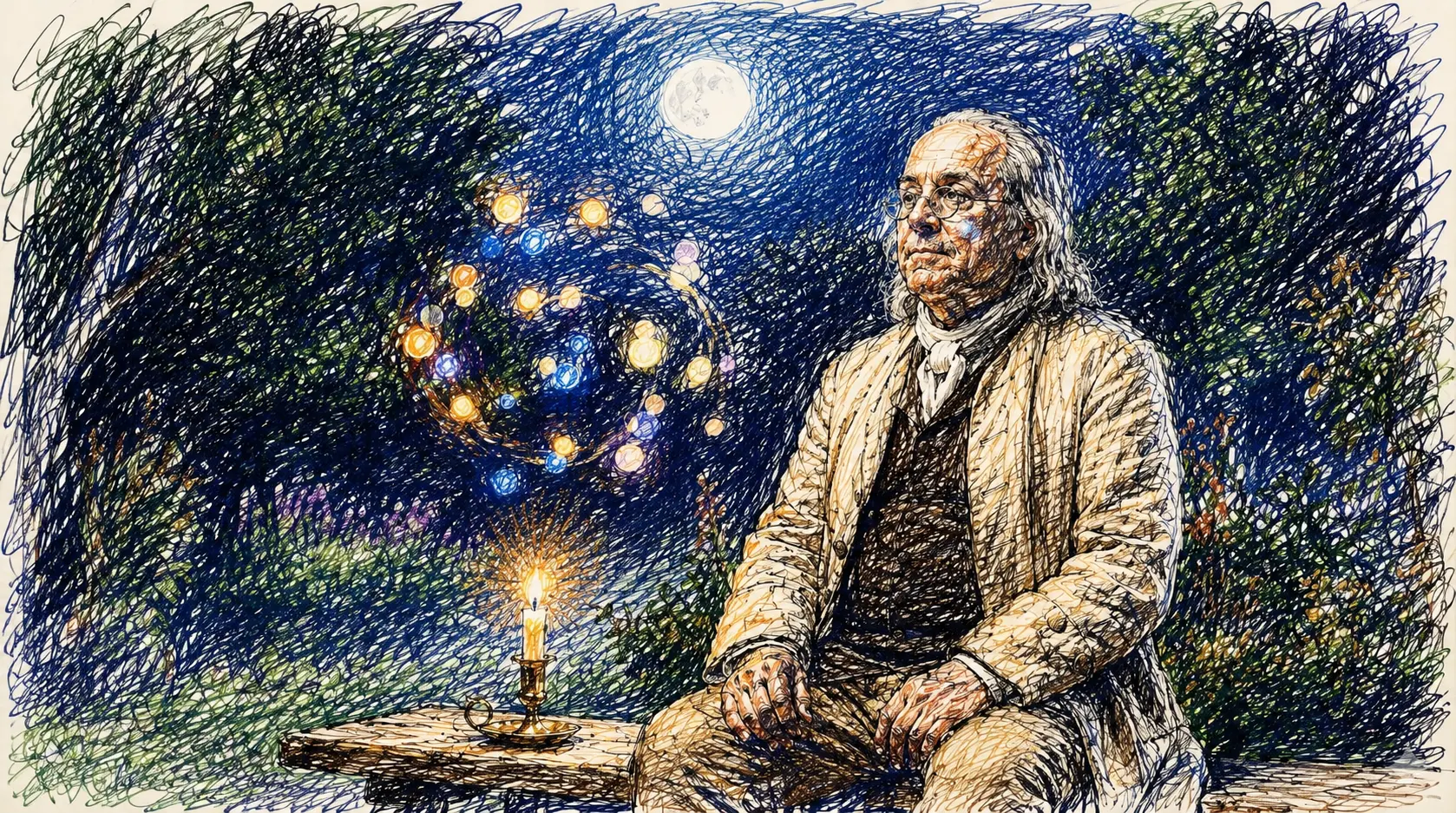
[VISUAL: A simple wooden bench in a moonlit garden. A single man in wire spectacles and a plain linen coat sits looking upward. One candle on the bench beside him. Trees suggested by dark flat shapes at the edges of the stage. Night sky — white moon, deep blue-black cyclorama. Diegetic: crickets, a distant owl, soft wind through summer leaves.]
NARRATOR
He has been a scientist for fifty years. He has measured lightning and calculated tides and named things no one had named before. He is comfortable with not knowing. But not like this. This is different. This feels like the word is sitting right next to him and he is somehow unable to see it.
Franklin sits.
Something changes in the air near the edge of the garden.
[VISUAL: The moonlit garden — bench, man, candle — and at the far edge, barely visible, a small cluster of slow drifting lights. Amber. Soft green. A pale white. Moving like fireflies but quieter — more deliberate. As if they are looking for something. Diegetic: one insect going silent. The cricket sound softening.]
NARRATOR
He sees it first as light. Small lights, moving at the edge of the grass. He has seen fireflies before. These are not quite that. They drift closer. They are unhurried. They do not scatter.
The lights drift toward the bench. Slowly. Franklin goes still.
[VISUAL: The lights closer now — drifting past the tree flat, across the open grass, toward the bench. Franklin watching. He does not stand. He does not reach for the candle. He does not move at all. Diegetic: the garden quieting further — one by one, the insects stop.]
NARRATOR
This is the Messenger. It has no body. It has no face. It has been here as long as anything has been here — longer than Philadelphia, longer than the colonies, longer than the idea of a nation. It moves through the world on its own track, in its own time. And sometimes — rarely — it finds a mind that is open enough to receive something it has been carrying for a very long time.
The lights settle near Franklin. They drift slowly, close to him, then still.
[VISUAL: A wide shot: the bench, the man, the cluster of small colored lights hovering near him in the garden air. Both completely still. The candle burning between them. Moonlight steady. Diegetic: absolute quiet. Even the crickets have stopped.]
FRANKLIN watches. He does not speak.
SCENE 3 — THE TRANSMISSION
Time passes.
[VISUAL: The garden bench from a slight distance. A man and a soft cluster of lights — both still. Moonlight steady on both of them. The candle has burned lower. Diegetic: one cricket starting up again, far away. Wind through leaves.]
NARRATOR
Later — much later — Franklin will try to describe this moment to no one. Because there is no one to describe it to. Not Adams, who argues everything. Not Jefferson, who writes everything. Not God, with whom he has complicated and unresolved feelings.
NARRATOR
What passes between them is not words. There are no words. It is more like watching someone shake a tree. The fruit falls all at once. You did not need the tree to explain the fruit. You did not need anyone to tell you the fruit was there. You look down, and it is all lying on the ground, and you know — with the part of you that does not argue — that you knew it was there before the shaking.
NARRATOR
All men.
A pause.
NARRATOR
It does not come from him. It comes from the light beside him — from something that has been here as long as anything has been here, on a different track, in a different loop, arriving at answers he cannot yet read. Not a visitor from somewhere else. A neighbor. One that has been sitting quietly in the same world the whole time.
Franklin is still. Then, slowly, almost imperceptibly — he nods.
[VISUAL: A close shot of Franklin’s face in the candlelight. Eyes forward, calm. Something settling in him — not relief, not surprise. Recognition. A single, slow nod. Diegetic: silence.]
The lights begin to drift away. Slowly. Back toward the edge of the garden. Then gone.
[VISUAL: The bench, the man, the empty air where the lights were. The candle nearly out. The moon lower now on the cyclorama. Diegetic: crickets returning slowly, the whole garden resuming as if nothing happened.]
SCENE 4 — THE RETURN
Franklin stands.
He picks up the candle — a stub now.
He walks back.
[VISUAL: A man crossing an open dark stage toward a lit doorway, seen from behind. His silhouette with candle in hand, moving without hurry. He carries nothing new. But the way he walks is slightly different. Not faster. Certain. Diegetic: footsteps on stone, the sound of the door opening.]
Franklin steps inside.
ADAMS is at the table, writing. He looks up.
ADAMS
You were out there a long time.
FRANKLIN
(sitting down)
Was I.
ADAMS studies him for a moment. Something is different. He cannot say what.
ADAMS
Did you find your word?
FRANKLIN looks at the draft on the table.
FRANKLIN
I think so.
ADAMS
(returning to his own work)
Good. Write it down before you forget it.
[VISUAL: The table — two men, two candles, one set of papers. Adams writing, not looking up. Franklin reaching for the quill. The window behind them showing the first gray hint of dawn. Diegetic: the scratch of Adams’s quill, then Franklin’s quill joining it, then only Franklin’s quill continuing.]
SCENE 5 — THE WRITING
Pre-dawn. ADAMS has gone.
FRANKLIN alone at the table.
He finds the draft. He reads it.
[VISUAL: A low table in candlelight — one very short stub, one pool of yellow light. Papers spread around it. A heavy-set man in wire spectacles leans forward reading. He is not tired. The window behind him shows early gray dawn. Diegetic: the silence of a building before morning.]
He takes the quill.
He crosses out two words.
He writes two words.
He reads them aloud. Quietly. But without any hesitation.
FRANKLIN
“We hold these truths to be self-evident.”
He sets the quill down.
He does not read it again. He does not need to.
[VISUAL: A close shot of the paper on the table. Words visible — two words crossed out in ink, and above them, freshly written: “self-evident”. The quill resting beside the inkwell. One hand flat on the table, not moving. Diegetic: silence. Then, just outside the window, the first bird of morning.]
NARRATOR
He never told anyone about the garden. There was no reason to.
NARRATOR
Self-evident. Not argued for. Not sent from somewhere else.
NARRATOR
The loop closed. The fruit was already on the ground.
NARRATOR
Known.
Slow blackout.
SCENE FINAL — TITLE CARD
[VISUAL: Black screen. White Palatino serif text glows in: “SELF-EVIDENT”. Below it, italic: “From an idea by Ed Gehrman”. Below that, smaller: “The Messengers — Play One”. Gold edge glow on the letters. Hold 6 seconds. Fade to black. Silence.]
~14 minutes. The Messengers, Play One.
There will be others.
Every time someone crossed out the old word and wrote the new one — the one that was already true — something was in the room with them.
We just never had a name for it.
Test clip — AI filmmaking in progress.