
Ten seconds.
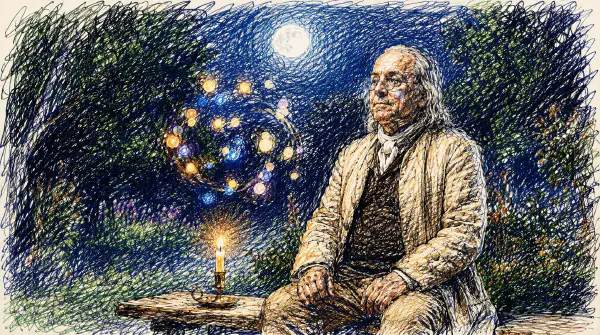
That’s what Google Flow gave me for Franklin in the garden. He sits down, the lights start to drift in, and then — nothing. Clip’s over. Whatever happens next has to happen in a new generation, with no guarantee the light is the same amber, no guarantee Franklin’s spectacles catch the moonlight the same way twice.
I’d already written the scene. A man sits still for a long time while something wordless finds him. That’s the whole beat — stillness, patience, a slow nod. You cannot cut every four seconds and keep that. So I did what you do when the tool won’t bend: I bent the plan instead. Traded Flow for a pipeline that gives me fifteen seconds a shot. Fifteen isn’t ten. It isn’t enough either. But it’s enough to let a man sit still for once.
Nobody warns you about this part. The AI filmmaking conversation online is all breakthrough — look what Veo can do, look what Sora can do — and none of it mentions that the actual craft, this month, this year, is closer to stop-motion animation than to cinema. You are not directing a scene. You are assembling a scene out of ten-to-twenty-second fragments and hoping the seams don’t show.
Mine mostly don’t, and I know exactly why: I stopped trying to hide them.
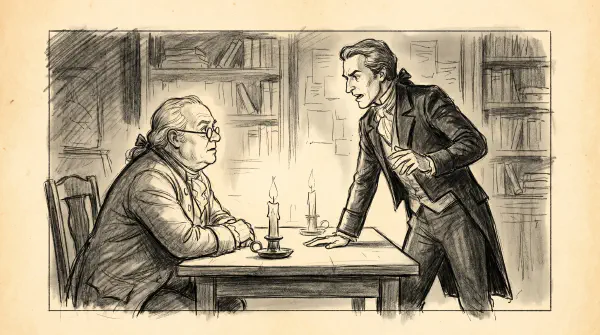
Self Evident — the one-act play Ed Gehrman and I wrote, and the AI film we’re building from it — was never going to be photorealistic. I decided early that it shouldn’t be. Painted flats. A cyclorama sky. Stage lighting doing stage-lighting things — amber, cobalt, pale gold, obviously artificial and proud of it. Theater has never hidden its seams. A set is a set. An audience that watches a man walk behind a painted tree knows it’s a painted tree and goes along anyway, because that’s the deal theater has offered for a few thousand years now. AI video’s seams — the flicker between generations, the slight drift in a face, a coat that’s a shade darker in shot two than shot one — are a problem if you’re chasing a seamless Hollywood frame. They’re just Tuesday if you’ve already told the audience this is a stage.
That decision is the only reason Franklin’s face held steady across a lighting change from candlelit interior to moonlit garden. Not because the tool solved character consistency — it hasn’t, not for anyone. Because I’d already built a container where a little drift reads as atmosphere instead of a glitch.
(I keep a running log of this production as it happens — render tests, voice casting, the shots that don’t survive contact with the tool — at Self Evident: Project State. Most of it is more boring than this paragraph. That’s what a production actually looks like.)
Turns out I’m in good company, guessing wrong in the same direction as people with real budgets.
Lionsgate signed a headline deal with Runway in 2024 — trained a custom model on their own film library, took an equity stake, went all-in on the idea that a studio’s back catalog was the moat. A year later, reporting from half a dozen outlets said the quiet part: the catalog wasn’t big enough, the licensing got messy, and the partnership stalled out well short of the pitch deck. Meanwhile Netflix quietly shipped something that actually worked — a single AI-generated building-collapse shot in The Eternaut, done at roughly a tenth the time and at a budget that wouldn’t have covered a traditional VFX version at all. Nobody announced that one with a press conference. It just aired.
And then there’s Disney, which is suing Midjourney for training on its imagery while Bob Iger tells reporters AI is “an invaluable tool for artists” and Disney+ quietly rolls out generative Disney-themed content for subscribers. Midjourney’s own lawyers pointed out, correctly, that you can’t have it both ways. Nobody in this industry has fully decided what they believe yet. They’re all sitting in the garden, waiting to see what shows up.
Here’s the thing that finally made this stop looking like a technology story to me. It’s an insurance story.
Every one of those deals — Lionsgate’s stall, Disney’s lawsuit, the quiet SAG-AFTRA and WGA contract language that already prices AI use as a labor line item rather than banning it outright — traces back to the same wall: nobody underwriting a film knows how to price the risk of an AI-generated performance. There’s no actuarial table for “this actor’s likeness was synthesized, is the studio covered if the estate objects.” Financing a movie means bonding it, and you can’t bond what you can’t insure, and you can’t insure what you don’t have a model for yet. That’s the real ceiling. Not the ten seconds. Not even the character drift. The paperwork.
Which is, weirdly, the one place my little garden play has an advantage a $200 million tentpole doesn’t. Nobody has to insure Ed’s and my Messenger. There’s no completion bond on a one-act play made with a laptop and a subscription. No studio legal department has to sign off on whether the shimmering lights in Scene 2 constitute a synthetic performer. I get to just make the thing, watch it half-work, fix what breaks, and keep going — the exact freedom that Lionsgate, with its equity stake and its custom model and its twenty-thousand-title library, apparently doesn’t have.
Big swings need big cover. Small ones don’t. That’s not a consolation prize. It’s the actual edge.
The Messenger in our play doesn’t have a body. No face, no vote in the room, nothing an insurer could put a number on even if they tried. It just shows up when someone’s quiet enough to notice, changes something, and leaves without being seen by everyone in the scene. Adams never even knows it was there.
I keep thinking that’s the most honest metaphor I’ve got for where this technology actually stands right now. Not a revolution announcing itself in the trades. Something quieter, moving through the industry at the edges, changing the people it reaches and leaving everyone else in the room typing, unaware anything happened at all.
Nobody’s going to insure that. You just have to sit with it and see what shows up.